
Hanyang Chen
(陈晗阳)
Beyond English: Uncovering the Multilingual Gap in Vision-Language-Action Models
July 13, 2026
Authors: Hanyang Chen, Hongliang Li, Jiarui Cao, Yang Jiang, Haonan Wen, Kaiyu Huang, Shengnan Guo, Huaiyu Wan
Affiliation: Beijing Jiaotong University
Links: https://alphaxiv.org/abs/2606.15714
TL;DR
Vision-Language-Action (VLA) models are typically trained and evaluated with English-only instructions. We present the first systematic study of multilingual instruction following in VLAs and show that:
- A large multilingual gap exists: non-English instructions cause sharp performance drops, sometimes close to the no-instruction baseline.
- The gap has two causes: instruction misunderstanding and action-execution failure.
- The root cause is representational: multilingual inputs shift the VLM backbone’s embeddings away from English.
- A simple fix helps: MPCA aligns multilingual embeddings in the principal-component subspace and closes most of the gap.
Why Multilingual Evaluation Matters
Robots will be deployed globally and must understand Chinese, French, Arabic, Russian, and many other languages. A common assumption is that multilingual VLMs such as Qwen-VL automatically transfer their language skills to downstream VLAs.
They do not. During language-to-action alignment, VLAs can become implicitly biased toward English, causing large performance drops on other languages.
Our Framework
We translate existing robot benchmark instructions into Chinese, French, Russian, and Arabic, and also create code-switching variants (e.g., “pick up 碗”). Evaluation is done on LIBERO and SimplerEnv via a Multilingual Evaluation Adapter.
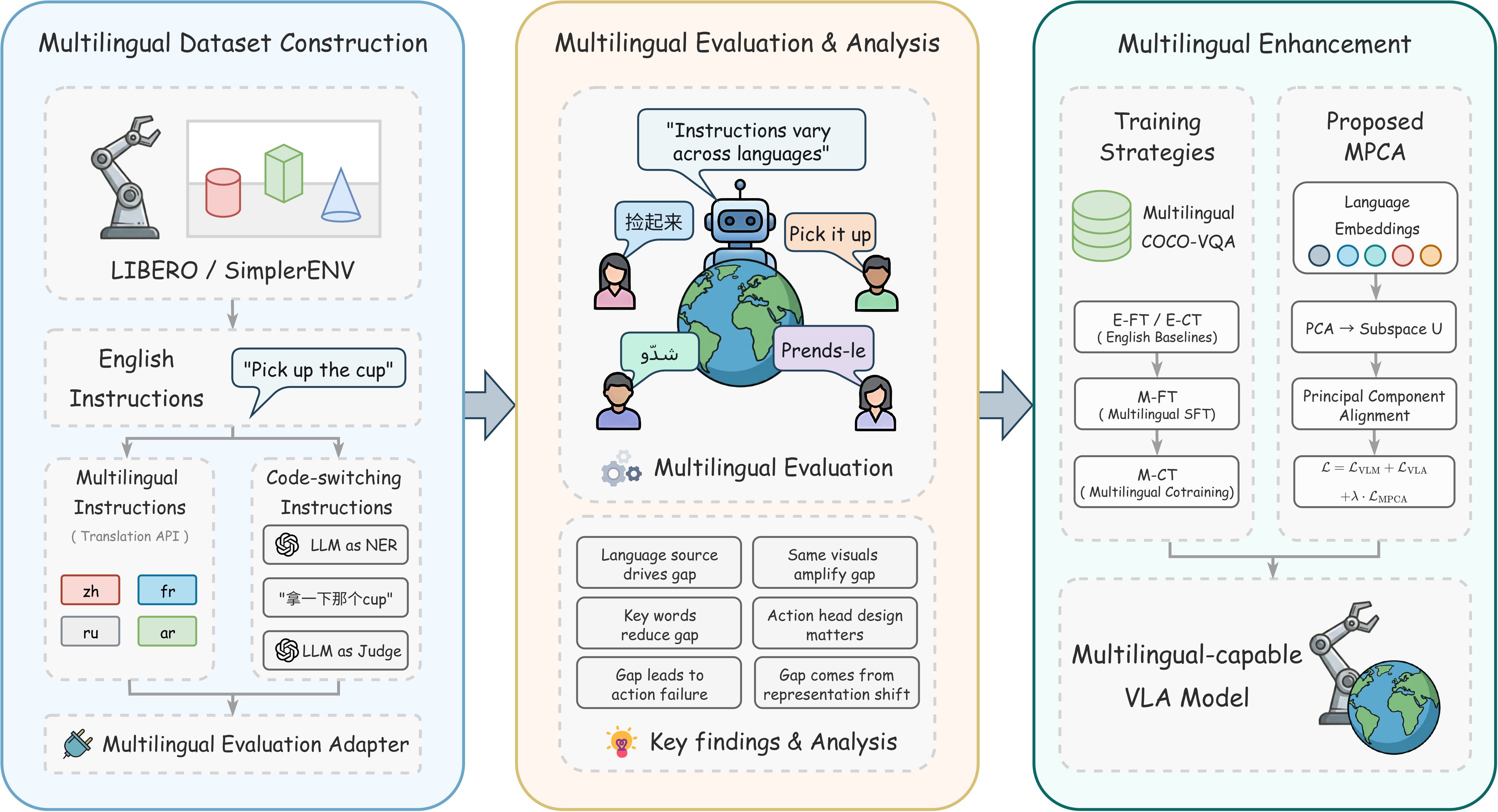 Figure 1: Three-stage pipeline: instruction construction → evaluation & analysis → performance enhancement.
Four Key Findings
1. The Base VLM’s Language Coverage Drives the Gap
English-centric VLMs (π₀.₅, OpenVLA-OFT, Cosmos Policy) collapse on non-English instructions. Qwen-VL-based VLAs generalize much better, especially to Chinese.
| Model group | Model | Avg. drop on non-English | No-instruction baseline |
|---|---|---|---|
| English-centric | π₀.₅ | –40.2 | –43.5 |
| OpenVLA-OFT | –28.7 | –27.5 | |
| Cosmos Policy | –37.2 | –47.9 | |
| Multilingual | ABot-M0 | –26.1 | –31.9 |
| Qwen3-VL-GR00T | –28.5 | –48.0 | |
| Qwen3-VL-π | –36.1 | –55.4 |
Table 1: Average relative performance drop on LIBERO (%). Lower is worse. English-centric models often fall to the no-instruction floor.
2. Similar Visual Scenes Magnify the Gap
In LIBERO-Goal, tasks look almost identical visually, so the model must rely on language to tell them apart. This is where the multilingual gap is largest.
3. Preserving English Keywords Helps
Code-switching instructions (e.g., “pick up 碗”) outperform fully translated instructions (e.g., “拿起碗”) across almost all models. Key verbs and nouns carry critical semantic weight.
4. Action-Head Design Matters
| Action head | Multilingual performance | Reason |
|---|---|---|
| GR00T-style / π-style | Best | Diffusion transformer retains language semantics and adapts to distribution shift |
| OFT-style | Moderate | MLP action head cannot fully adapt to shifted representations |
| FAST-style | Worst | FAST tokenizers may discard semantic information from VLM outputs |
What Is Happening Under the Hood?
Two Failure Modes
 Figure 2a: Instruction misunderstanding — the French “turn on the stove” is confused with “put the bowl on the plate” in LIBERO-Goal.
 Figure 2b: Action-execution failure — the Chinese instruction is understood, but the grasp-and-place motion is wrong.
Representation Shift
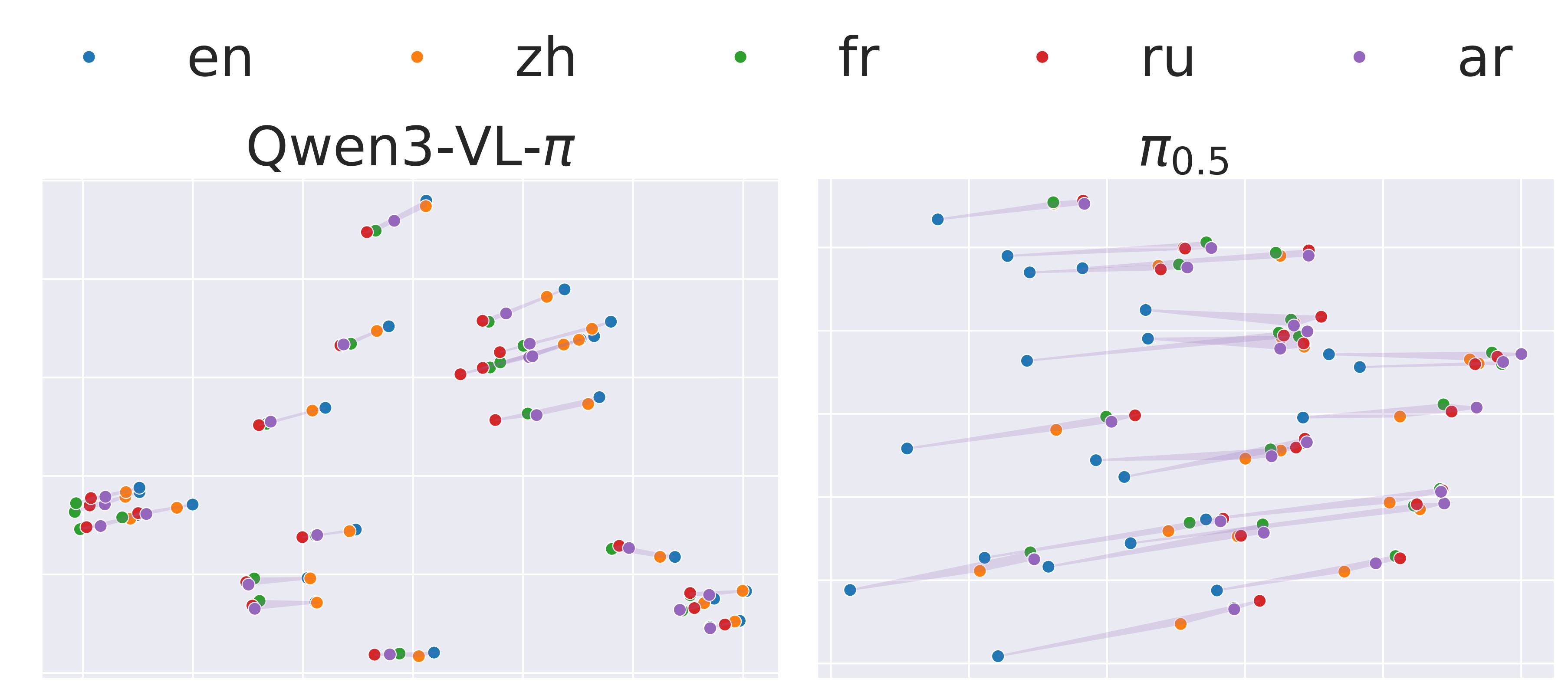 Figure 3: Average-pooled embeddings from the middle layer. Qwen3-VL-π (left) keeps English and Chinese closer; π₀.₅ (right) pushes all non-English embeddings far from English.
Embedding distance correlates with performance: better cross-lingual alignment predicts better multilingual execution.
How to Improve It: MPCA
We fine-tune on a 50K multilingual COCO-VQA dataset and compare strategies:
- M-FT: multilingual fine-tune the VLM, then train the action head.
- M-CT: co-train the VLA on multilingual COCO-VQA and LIBERO.
- MPCA: align multilingual instruction embeddings onto the principal-component subspace of English embeddings.
| Model | English | Chinese | French | Russian | Arabic | Avg. non-English |
|---|---|---|---|---|---|---|
| GR00T | 95.3 | 89.1 | 62.3 | 56.5 | 59.3 | 66.8 |
| M-FT | 95.4 | 87.6 | 65.1 | 57.1 | 62.8 | 68.2 |
| M-CT | 92.6 | 88.3 | 87.4 | 83.1 | 89.4 | 87.1 |
| MPCA | 95.3 | 90.6 | 89.5 | 85.5 | 90.8 | 89.1 |
Table 2: Average success rate (%) across LIBERO suites. MPCA keeps English performance while lifting the non-English average by ~22 points over the baseline.
The key idea: align only the most significant principal components and let minor components retain language-specific information.
\[\mathcal{L} = \mathcal{L}_{\text{VLM}} + \mathcal{L}_{\text{VLA}} + \lambda \sum_{i=1}^{n} \sum_{j=1}^{m} \left(1 - \cos(\mathbf{U}^T \mathbf{h}_{i, j}, \mathbf{U}^T \mathbf{h}_{i, \text{en}})\right)\]Takeaway
- Multilingual VLAs are not a free lunch — even multilingual VLM backbones can fail after language-to-action alignment.
- The gap is explainable through misunderstanding, execution failure, and backbone representation shift.
- Practical takeaways: pick a multilingual backbone, prefer diffusion action heads, keep English keywords when possible, and apply MPCA to align principal components.